
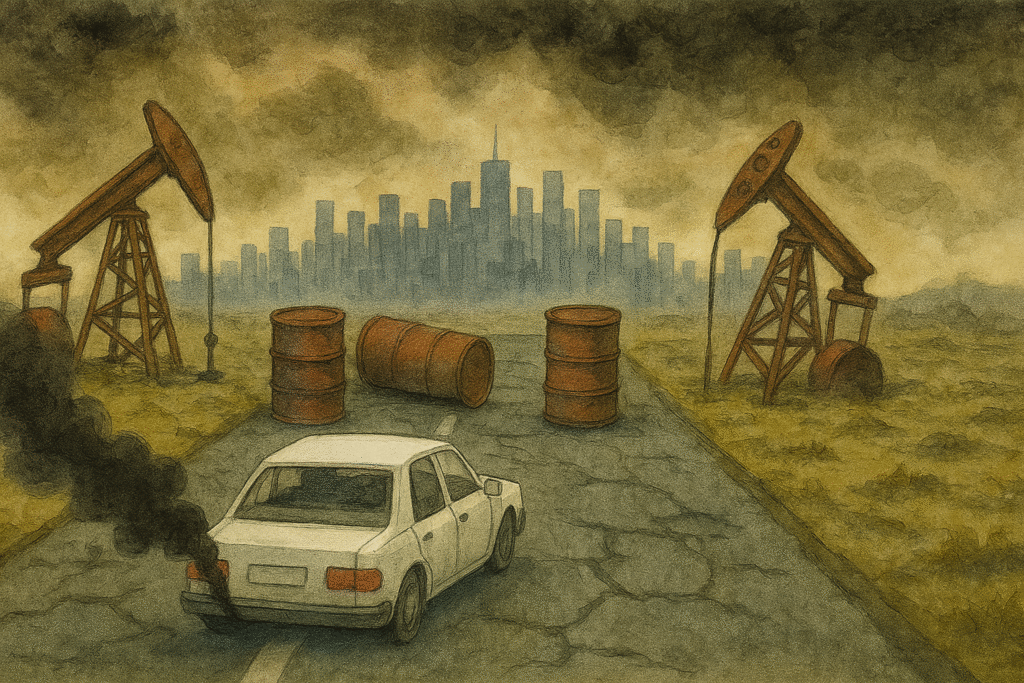
A double dead end, even. An ecological and energy dead end. So much so that public authorities around the world are seriously considering the end of new combustion vehicles within just fifteen years. Are they “out of touch” with reality, as we often hear, or, on the contrary, is this not an elementary precaution in light of current scientific and technical knowledge? Is the petrol car living its last years?
A – Ecological dead end :
Greenhouse gases
The main emission of fossil fuel combustion is CO2, known for its impact on the global climate. European and global automotive regulations are justified by the need to limit CO2 emissions. Everything is done to limit the consumption of thermal engines in order to limit their CO2 emissions while trying to get the highest possible efficiency and continue to display flattering performances. New 100% thermal vehicles emit 109g of CO2 per km for an average power of 120 hp (horsepower). And this without taking into account the CO2 emissions linked to the extraction, refining and transport of the fuel. Over 100,000 km, a recent thermal car will therefore emit 10.9 tons of CO2 just while driving. Over 300,000 km, it will be 32.7 tons!
Toxic gases and particles
In addition to CO2, the combustion of fossil fuels results in the emission of other polluting and toxic gases:
- Carbon monoxide CO
- Nitrogen oxides NOx
- Ozone
- Ammonia
- Soot and unburned Hc hydrocarbons
Particulate filters have only shifted the problem and do not make combustion engines cleaner. Indeed, diesel FAP engines must regularly perform what is called pyrolysis regeneration to prevent clogging and breakdown. This regeneration is only supposed to occur on motorways when the engine speed remains high for a certain period of time. However, most diesels do not make long motorway journeys regularly because they only make short journeys in the city. The system is therefore forced to perform pyrolysis in these conditions in the city.
And during this phase it appears that the vehicle emits 1000 times more fine particles than normal according to certain studies!1
This regeneration occurs automatically every 1500 km or so. This means that the DPF rejects everything it has retained over the last 1500 km, or barely the last 3 tanks. It is even recommended to “force” the regeneration by driving at high revs every 300 km or so!2
And this only transforms fine PM1 particles into even more harmful ultrafine particles (PM<1).
“Harmful total particulate emissions […] further increased 11-184% when the smallest unregulated ultrafine particles were measured in the lab. These ultrafine particles are not measured in official tests but are thought to be the most harmful to human health – as they penetrate deep into the body – and have been linked with brain cancer.“
Transports & Environnement – January 10 – 2020
DieselGate
In addition to these fine particles for which the particulate filter is used, there is also another system for depolluting diesels: reducing NOx by adding urea to the exhaust system. This system is at the very heart of the “DieselGate” scandal. Indeed, the quantity of urea reagent (AdBlue for its commercial name) required to completely depollute these engines far exceeds the size of the classic AdBlue tank. In reality, you should fill up with AdBlue every 1,000 km, not every 30,000.
This means that the system generally only works when placed in conditions close to those of the homologation tests. The rest of the time, to save AdBlue, the pollution control system simply does not work. And when it does work, it is only partially effective, and therefore, in addition to untreated NOx, AdBlue engines also emit ammonia, a highly irritating gas resulting from incomplete reactions between AdBlue and NOx.

DPF and AdBlue only sweep the dust under the rug. They don’t eliminate combustion engine pollution. At best, they only temporarily contain it.
Noise pollution
This is also a reason for the gradual banning of combustion engine vehicles from city centers: their noise. Especially diesel engines when starting. At night, the noise of diesel engines is even more audible. Although the noise of a moving car is not only due to the engine but also to the tires, we can still expect a reduction in noise by a factor of three by switching to an electric motor.
Oil extraction and refining
Oil extraction and refining are among the activities that generate the most direct and indirect pollution of all human industrial activities. The catalysis of hydrocarbons requires a huge quantity of rare earths and precious metals. The oil industry is a very large consumer of cobalt, for example, while the controversy over its extraction is mainly attributed to the electric car. Cobalt is found in fuels because it dissolves during catalysis. It also uses other precious and rare metals in large quantities, such as palladium. Catalytic converters and particulate filters also contain a certain amount of rare earths and precious metals. It also generates significant radiological pollution due to the massive extraction of radioactive rocks during drilling. The oil industry also generates radioactive pollution!
Conclusion
Manufacturers admit it: they have reached the limits of thermal engines and it is now impossible for them to further reduce greenhouse gas emissions and other pollutants.
Particulate filters and urea-based NOx reduction systems like AdBlue are not enough to make internal combustion engines clean enough. And although diesel engine sales are plummeting in Europe for private individuals, utility vehicles continue to represent a significant proportion of new vehicles put on the road.
Gasoline and hybrid gasoline engines undoubtedly emit less soot, but this comes at the cost of higher CO2 emissions. Although CO2 is not toxic, its role as a greenhouse gas is not negligible.
Ultimately, the problems of air pollution, noise and global warming will continue to accumulate with thermal vehicles.
This is a major impasse because we can no longer continue to pollute the atmosphere in this way. Not only does the fossil-fueled automobile industry no longer have any room for growth, but it will also have to decline significantly to avoid condemning future generations.
B – Energy dead end :
This is the point that is probably least taken into account: oil is an exhaustible resource, and it is inevitably running out.
A quick overview of the world’s proven reserves3 shows that we don’t even have 50 years of cheap, good-quality oil left!4 Yet it is this cheap, good-quality oil that is essential for the combustion engine car. So, even before we reach the last drop of oil, the concern about the cost of extracting and refining current reserves will already pose a serious limit to the use of oil as a fuel. It should be noted that the automotive alone represents around 45% of annual oil consumption.
Proven reserves vs. annual consumption
Oil consumption in 2025 is currently around 100 million barrels per day (mb/d), which represents 36.5 billion barrels per year. In 2022, total oil production reached 34 billion barrels. In 2023, consumption reached an all-time high of 109 mb/d5 in April. The automotive alone currently consumes 45 mb/d, or 16.4 billion barrels per year.
According to the most recent estimates, the world’s proven reserves are approximately 1,700 billion barrels. A simple calculation is sufficient to determine that at the current rate of consumption, these reserves will be exhausted in exactly 46 years.
The United States is at the forefront of hydraulic fracturing extraction. But water resource and logistical problems are already limiting. And according to the latest available official figures, their proven crude oil reserves are 46 billion barrels for a production of 4.8 billion barrels in 202467. So they will be exhausted in less than 10 years at the current rate. Especially with their political (not to say demagogic) desire to be the world’s leading producer. Their current production of 13 mb/d, unsustainable in the long term, does not cover their consumption of 19 mb/d. They are also, by far, the world’s leading consumers, ahead of China.
Conventional vs. Unconventional Oil
But beyond these raw and quantitative figures of proven reserves, it is also appropriate to look at the quality of these reserves. Indeed, there are essentially two types of oil.
> Conventional oil is easy to extract and refine. It is liquid (light, medium, or heavy) and contained in a reservoir formed by impermeable rock layers. This oil is easy to extract because it is enough to drill a well and the liquid oil gushes out under pressure. Reserves of this type are located mainly in the Middle East (Saudi Arabia 300 billion barrels, Iran, Iraq 100 billion barrels, for the largest reserves), and to a lesser extent in Africa (Algeria 12.2 billion barrels, Nigeria 37.5 billion).
> And the unconventional oil8, because of either its intrinsic nature (extra-light, extra-heavy or bituminous), or the location from which it must be extracted, which requires means other than conventional wells (ultra-deep offshore or hydraulic fracturing).
The difference between the two is very important because unconventional oils ultimately do not have the same energy and economic yield. Indeed, they require much more resources to extract and refine them.
Which brings us to consider EROEI and the price of a barrel. It’s not just about having oil; you have to consider how much energy you need to invest for the amount of oil you get, and whether it’s still “cheap” enough to power millions of vehicles every day.
EROEI
Energy Returned On Energy Invested9 refers to the ratio between the amount of energy invested in the extraction and production of an energy source and the amount of net energy obtained from it.
For conventional oil, the rate is around 15 to 1. This means that for every barrel of oil invested in a field, 15 are returned. For unconventional oil, this rate is much lower.
“The equivalent of 23% of the energy contained in a barrel of oil is required to produce one barrel from oil sands (compared to 6 to 7% for a conventional onshore oil field).”
Connaissance des Énergies – June 24 – 2024
For the tar sands of Canada and Venezuela (which constitute the largest oil reserves to date), this ratio is only 3 to 1 in the end. The same goes for American shale oil, because it takes enormous energy and resources, including water and chemicals, to fracture the rock and recover the oil.
Ultra-deep offshore drilling also requires a lot of energy and resources, often located tens or even hundreds of kilometers offshore, making their construction and maintenance expensive and complicated. Not to mention the risk of a massive disaster, such as the Deep Water Horizon in 2010. A single well of this type costs more than ten billion dollars, the same as a nuclear power plant.
Here is a summary table of the main proven reserves by country and what this represents in terms of global consumption at the current rate of 100 mb/d :
| Country ranking | Proven reserves (in billions of barrels) | Type | Years of global consumption |
| 1. Venezuela | 303,29 | Oil sands – unconventional | 8,3 |
| 2. Saudi Arabia | 297,64 | Conventional crude | 8,15 |
| 3. Canada | 167,82 | Oil sands – unconventional | 4,6 |
| 4. Iran | 155,60 | Conventional crude | 4,26 |
| 5. Iraq | 147,22 | Conventional crude | 4 |
| 6. Kuwait | 101,50 | Conventional crude | 2,78 |
| 7. United Arab Emirates | 97,80 | Conventional crude | 2,67 |
| 8. Russia | 80,00 | Conventional crude | 2,19 |
| 9. Libya | 48,36 | Conventional crude | 1,32 |
| 10. United-States | 46,4 | Shale oil – unconventional | 1,27 |
| 11. Nigeria | 37,45 | Conventional crude | 1,02 |
Proven unconventional reserves will not be fully recovered and will not ultimately yield the same quantity of barrels as conventional deposits.
So it is obvious that these remaining 46 years are an absolute maximum.
Peak Cheap Oil
Many analysts and commentators question peak oil and peak cheap oil, despite common sense. But when it comes to conventional oil, this peak production has already been reached for several years. There have been no new conventional oilfield discoveries for over 20 years, and there probably never will be again.
The small increase in proven reserves does not come from new deposits but from unconventional deposits reclassified as proven reserves because the increase in the price of a barrel and new technologies make them exploitable and profitable, but they are no longer “cheap” or of good quality. The production of cheap oil is already in decline. Saudi Arabia’s reserves of good quality oil will only last 10 to 15 years at our current rate, and there will be no new conventional reserves.
A glance at this graph shows the scale of the problem :
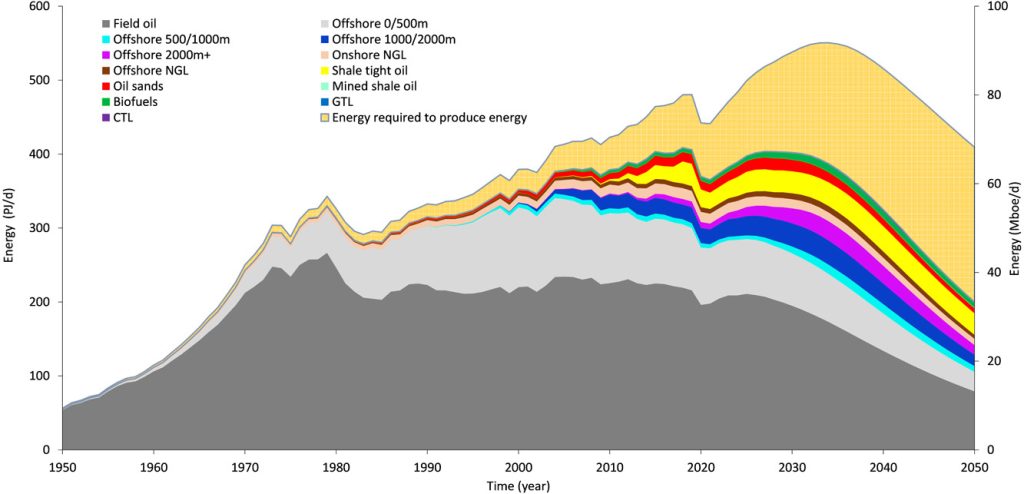
Those like Donald Trump who deny peak oil are completely blind. We clearly see the first oil shock of 1973 followed by that of 1979, which corresponds to an absolute peak in conventional onshore oil production. Peak oil did indeed occur in 1979!
Then we can clearly see that conventional offshore oil in light gray actually peaked in 2005! Conventional oil production, including offshore, has already been in decline for nearly 20 years! This is not the future, but already the past!
The only thing that has prevented a decline in global production are unconventional resources, which require more and more energy for their own exploitation, as illustrated by the yellow curve. And this is barely enough to prevent an absolute decline that would be synonymous with a severe economic recession or even global armed conflicts.
It should also be noted that the drastic drop in production during the phase of general global lockdown due to the COVID 19 health crisis, to a certain extent masked the beginning of the geophysical decline in global oil production.
Conclusion
In view of current scientific and technical data, it seems clear that the thermal car is living its last two decades.
The end of new thermal vehicles from 2035 decreed by the European Union seems to be an elementary precaution to avoid a sudden collapse in the oil supply before 2050. Indeed, oil is not only used to fuel vehicles, it is also and above all an essential raw material for our modern society dependent on petrochemicals.
Going oil-free for our cars now is not only much healthier for the environment, but it’s also the only way to ensure a future as prosperous as it was under the era of cheap oil.
- https://www.transportenvironment.org/articles/new-diesels-particle-emissions-spike-1000-times-normal-levels-tests ↩︎
- https://www-autoplus-fr.translate.goog/pratique/How long do you really need to drive to avoid breakage?p ↩︎
- https://geoconfluences-ens–lyon-fr.translate.goog/glossaire/reserves-proven-possible-reserves ↩︎
- https://www-connaissancedesenergies-org.translate.goog/fiche-pedagogique/world-oil-reserves ↩︎
- https://www-lemondedelenergie-com.translate.goog/global-oil-demand-to-reach-new-record-in-2023 ↩︎
- https://www.eia.gov/dnav/pet/hist/LeafHandler.ashx?n=pet&s=mcrfpus1&f=a ↩︎
- https://www.eia.gov/naturalgas/crudeoilreserves/ ↩︎
- https://en.wikipedia.org/wiki/Unconventional_(oil_and_gas)_reservoir ↩︎
- https://www.sciencedirect.com/science/article/abs/pii/S0306261921011673 ↩︎
